
Ohio's largest city by land area
Asphalt Paving in Columbus, OH
Driveways, overlays, patching, sealcoating and parking lots from the older neighborhoods inside the outerbelt to the newest annexed subdivisions.
- Free on-site estimates
- Written quotes that state stone base depth and compacted asphalt thickness
- Right-of-way permit and OHIO811 locate steps handled before work starts
Paving a City That Keeps Getting Bigger
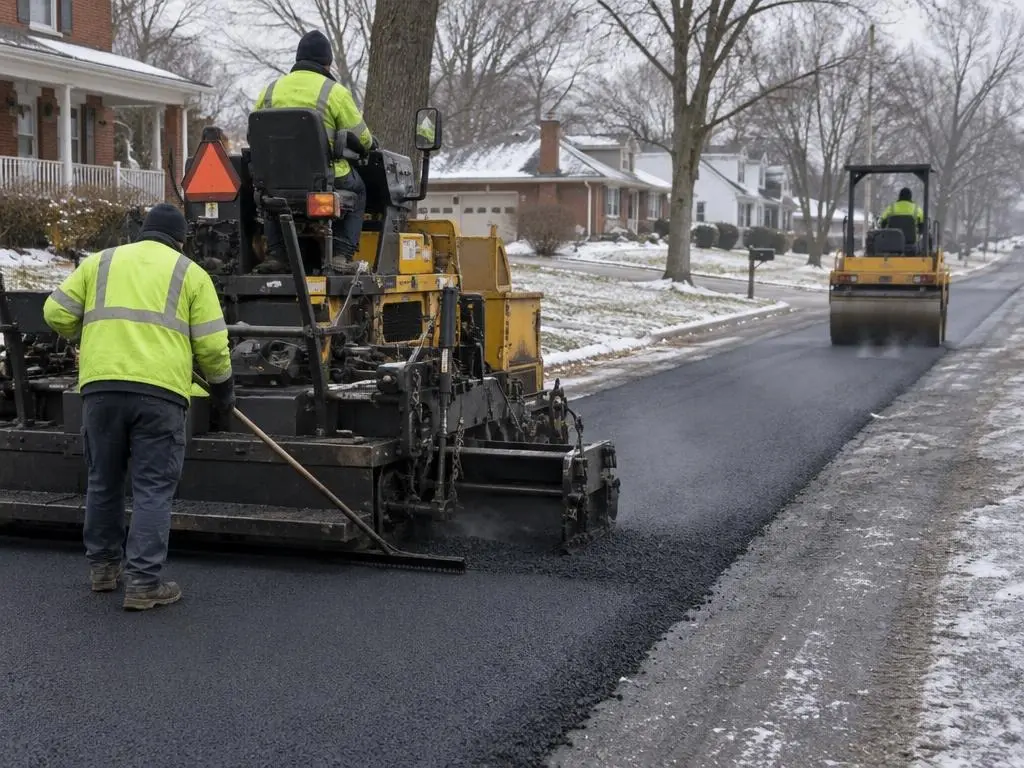
Columbus is our home market, and asphalt paving here covers more ground than anywhere else in Ohio. The city spreads over 223.11 square miles, the largest land area of any Ohio city, and Wikipedia ties much of that size to annexation linked to city water service. That history matters to a paving job. A driveway in a pre-war neighborhood near downtown sits on a narrow lot with an alley or a shared approach, while a driveway in a far-north or far-west neighborhood may be a wide two-car slab poured with the house a few decades ago. We replace driveways, resurface sound ones, patch failures, sealcoat, and pave and stripe business lots in both settings.
Flat glacial ground and where the water goes
Columbus has relatively flat topography because a large glacier covered most of Ohio during the Wisconsin Ice Age. Flat land is easy to build on and hard to drain. On a level lot there is very little natural fall to carry water off a driveway, so puddles sit in the low spots, soak into any crack and soften the stone base underneath. Once the base goes soft, the surface starts to show the classic signs: alligator cracking in the wheel paths, a dip by the garage, and edges that crumble into the lawn.
That is why every Columbus estimate starts with grade. We look at where water enters the driveway, where it leaves, and whether the downspouts empty onto the pavement. A new driveway or an overlay should shed water toward the street or a yard, not toward the garage door or the foundation.
Rain, heat and freeze-thaw in one year
The 1991-2020 normals at John Glenn airport show 41.57 inches of precipitation a year, with July the wettest month at 4.67 inches. The city also sits in USDA hardiness zone 6b, bordering on 7a, with a humid continental climate. In practice that means hot summer sun that dries and grays asphalt, heavy summer storms that test drainage, and winter nights that freeze any water sitting in a crack. Each freeze widens the crack a little. Sealing cracks in the fall and sealcoating every few years are the cheapest ways to slow that cycle down.
Ravines, shale and limestone
Wikipedia notes that tributaries to Alum Creek and the Olentangy River cut ravines through shale, while Scioto tributaries cut through limestone. Homes on ravine lots often have sloped driveways or a curve down to a garage below street level. Slopes move water fast, and that water carries fines out of the base along the edges. On those drives we pay close attention to edge support, compaction and where runoff ends up, and we may suggest a drain or a swale rather than repaving over the same problem.
Work we do across Columbus
- Driveway paving: full tear-out and new stone base, widening, and new aprons
- Resurfacing: a new asphalt layer over a driveway or lot whose base is still sound
- Asphalt repair: patching potholes, cutting out failed sections and fixing edges
- Sealcoating and crack filling: protection for pavement that is still in good shape
- Parking lots: paving and mill-and-overlay for shops, churches, offices and apartments
- Striping: layout and repainting of stalls, arrows and accessible spaces
The street, the curb and the right-of-way
In Columbus, the driveway entrance at the street is the owner's job. The city's curb brochure explains that under Columbus City Code 905.06 the abutting property owner maintains and repairs sidewalks and driveway entrances, including the curb up to the nearest tool joint on either side of the drive. A permit is required before any curb work starts. It costs nothing, the contractor or the owner can get it, and it is issued online through the city. The city also runs a curb reimbursement program for individual residential owners, limited by yearly funding, that requires a city inspection before work begins.
So if your driveway project includes a new curb cut, a dropped curb or a rebuilt approach, we pull the permit and plan the order of work so the curb, apron and asphalt tie together correctly. If you hope to use the reimbursement program, tell us at the start so the city can inspect the curb before anything is removed.
Outside the city limits
Some addresses with a Columbus mailing address are actually on township roads maintained by Franklin County. The Franklin County Engineer issues its own residential driveway permit for work in the county road right-of-way, with separate rules for drive tile and aprons. We confirm which agency has the road in front of your house before we schedule. Call (614) 963-2681 to set up a visit anywhere in Columbus, inside or outside the outerbelt.
Columbus Facts That Shape a Paving Job
- Land area. Columbus covers 223.11 square miles, the most of any Ohio city, largely due to annexation tied to water service.
- Glacial terrain. The city is relatively flat because a large glacier covered most of Ohio during the Wisconsin Ice Age.
- Annual rainfall. 1991-2020 normals at John Glenn airport show 41.57 inches of precipitation, with July the wettest month at 4.67 inches.
- Ravine geology. Tributaries to Alum Creek and the Olentangy cut through shale, while Scioto tributaries cut through limestone.
- Curb permit. A no-cost city permit is required before any curb work, and owners maintain driveway entrances up to the nearest curb tool joint under City Code 905.06.
Our Services in Columbus, OH
Columbus Questions
Do I need a permit to repave my driveway in Columbus?
Paving on your own lot is different from work at the street. Columbus requires a no-cost permit before any curb work, and the owner is responsible for the driveway entrance up to the nearest curb joint. If your job touches the curb or approach, we handle the permit before we start.
Why does water pond on my Columbus driveway?
Much of the city is flat glacial ground, so there is little natural fall. Ponding usually means a low spot or a settled base. We fix the grade during replacement or resurfacing so water runs to the street or yard.
Should I resurface or replace?
If the base is solid and cracks are mostly on the surface, resurfacing works well. If there is alligator cracking, soft spots or sinking, the base has failed and a tear-out with new stone is the better choice.
Will the city pay for my curb?
Columbus has a curb reimbursement program for individual residential owners, limited by annual funding. The city must inspect the curb before work begins, so let us know at the start if you want to apply.
Free Estimates in Columbus, OH
Tell us your street and what the pavement is doing, and we will set up a free on-site estimate anywhere in Columbus.
Asphalt Paving Near Columbus
- Asphalt Paving in Dublin, OH
- Asphalt Paving in Westerville, OH
- Asphalt Paving in Hilliard, OH
- Asphalt Paving in Grove City, OH
- Asphalt Paving in Upper Arlington, OH
- Asphalt Paving in Gahanna, OH
- Asphalt Paving in New Albany, OH
- Asphalt Paving in Powell, OH
- Asphalt Paving in Worthington, OH
- Asphalt Paving in Delaware, OH
- Asphalt Paving in Pickerington, OH
- Asphalt Paving in Reynoldsburg, OH
- Asphalt Paving in Canal Winchester, OH
- Asphalt Paving in Groveport, OH
- Asphalt Paving in Marysville, OH
- Asphalt Paving in Pataskala, OH
- Asphalt Paving in Plain City, OH
- Asphalt Paving in Bexley, OH
- Asphalt Paving in Circleville, OH
- Asphalt Paving in Sunbury, OH
- Asphalt Paving in Grandview Heights, OH
- Asphalt Paving in Whitehall, OH
- Asphalt Paving in Lewis Center, OH