
New driveways, replacements and gravel conversions
Asphalt Driveway Paving in Columbus, OH
The asphalt you see is only the top few inches. The stone and drainage underneath decide how many winters it lasts.
- Free on-site estimates
- Written quotes that state stone base depth and compacted asphalt thickness
- Right-of-way permit and OHIO811 locate steps handled before work starts
Driveways Built From the Base Up
Asphalt driveway paving around Columbus succeeds or fails underground. A new blacktop surface looks the same on day one whether it sits on eight inches of compacted stone or two inches of loose gravel over wet clay. The difference shows up after the first couple of Ohio winters, when the thin one starts sinking in the wheel paths, cracking in a web pattern and breaking at the edges. We build the part you cannot see first, then pave over it.
Signs a driveway needs replacing
- Cracks that connect into a web or alligator-skin pattern
- Ruts or dips that hold water or ice
- Potholes that return after every patch
- Edges crumbling into the lawn
- A surface that is now more patch than original asphalt
A few cracks or one bad spot can be repaired. When failures cover a large share of the driveway, replacement usually costs less over the next ten years than fixing the same spots again and again.
The subgrade
Much of Central Ohio sits on glacial till with clay-rich, slow-draining soils, and in late winter and spring the water table in those soils can sit close to the surface. After the old driveway is removed, we check the ground for spots that pump, move or stay wet. Those are dug out and filled with crushed stone. Then the base is built and compacted in lifts to the depth in your quote. HomeGuide describes a typical residential build as 2 to 3 inches of compacted asphalt over 6 to 8 inches of gravel base, and 3 to 4 inches of asphalt over 8 to 10 inches of base for heavier vehicles. If you park a pickup, a work van, a boat trailer or an RV, plan on the heavier section.
Pitch and drainage
On flat Columbus lots, the big risk is water that has nowhere to go. We set a crown or cross slope so the surface sheds water to the sides, keep the high point at the garage, and look for downspouts that empty onto the driveway. If water collects where the driveway meets the street or a sidewalk, we raise the problem at the estimate rather than paving it in.
Edges and the apron
Edges carry tires without the support of pavement on both sides, so they fail first. We compact them, taper them and backfill soil against them. At the street end, the apron and curb cut are usually in the public right-of-way. In Columbus, installing, removing or repairing a driveway approach takes the city's 905 right-of-way permit, and if the work does not meet city standards, the homeowner as permittee is responsible for fixing it. Suburbs and townships have their own processes. We tell you which applies and include it in the plan.
Gravel to asphalt
Many older homes on the edges of Franklin, Delaware, Licking and Fairfield counties still have gravel drives. An existing stone bed can sometimes become part of the new base, which saves money. We check how deep the stone really is, how much has sunk into the soil and whether the grade drains, then add stone, regrade, compact and pave.
The first season
Fresh asphalt is soft, especially in July heat. Keep vehicles off it for the time we give you, avoid turning your wheels while parked, and put a board under kickstands and trailer jacks. HomeGuide's driveway guide says to wait at least 24 to 48 hours before driving on it, 3 to 5 days in hot weather, and a week for heavy vehicles. Its guides differ on the first sealcoat (three to six months in the sealing guide, about a year in the driveway guide), so we give you a date based on when your driveway was paved.
What a Driveway Job Covers
Every step from tear-out to the last finished edge.
Tear-out and haul-off
Old asphalt, concrete or worn gravel removed and taken away.
Soft-spot repair
Wet or unstable subgrade dug out and replaced with crushed stone.
Compacted stone base
Base graded for drainage and compacted in lifts to the stated depth.
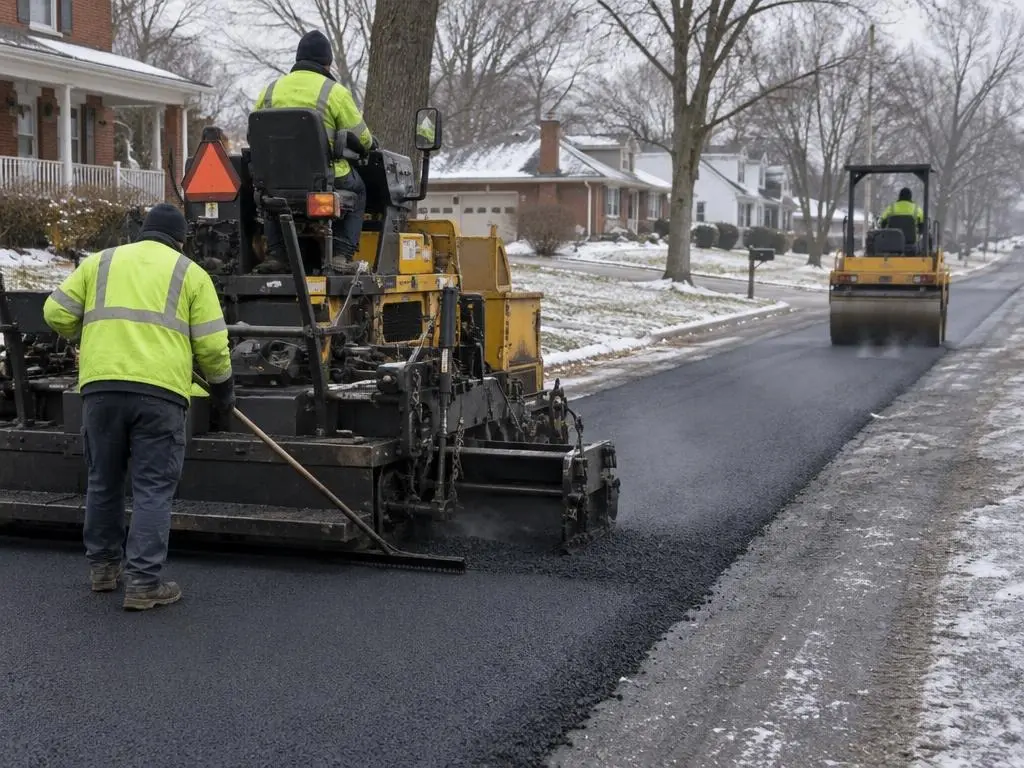
Hot-mix asphalt
Placed and rolled to the compacted thickness in your quote.
Edges and transitions
Supported edges and clean joints at the garage, walks and apron.
Typical Asphalt Driveway Costs
| Item | Published national range |
|---|---|
| New asphalt driveway (HomeGuide) | $5 to $12+ per sq ft |
| New asphalt driveway (Angi) | $7 to $15 per sq ft |
| 200 sq ft driveway (HomeGuide) | $1,000 to $2,400 |
| 400 sq ft driveway, about 20x20 (HomeGuide) | $2,000 to $4,800 |
| 500 sq ft driveway (HomeGuide) | $2,500 to $6,000 |
| Remove and replace (Angi) | $8 to $15 per sq ft |
| Driveway permit, typical (Angi) | $50 to $200 |
National ranges from published cost guides, which each build their numbers differently. Central Ohio prices can run higher or lower, and removal, base repair, access and the size of the job change the total. Your written estimate is the price. HomeGuide notes some contractors set a minimum charge of $2,000 or more.
How It Works
1. Site visit
We measure, check pitch and low spots, probe for soft ground and look at the street connection.
2. Written quote
Removal, base repair allowance, stone depth and asphalt thickness itemized with prices.
3. Permits and locates
Right-of-way permit filed where the apron is involved; OHIO811 contacted at least 48 working hours before digging.
4. Base work
Old surface removed, soft spots replaced, stone graded and compacted.
5. Paving
Hot mix placed and rolled, edges finished, care instructions handed over.
Asphalt Driveway Paving Questions
What does a new asphalt driveway cost in Columbus?
National guides list about $5 to $12 or more per square foot (HomeGuide) and $7 to $15 per square foot (Angi). For a 400-square-foot driveway, HomeGuide gives roughly $2,000 to $4,800. Removal, base repair and the apron change the total, so we quote yours in writing after seeing it.
How thick should a driveway be in Ohio?
A common residential section is 2 to 3 inches of compacted asphalt over 6 to 8 inches of stone base. For trucks, trailers or RVs, 3 to 4 inches over 8 to 10 inches is typical. On wet, slow-draining soil, the base matters as much as the asphalt.
Asphalt or concrete for a Columbus driveway?
Asphalt usually costs less up front, is quicker to install and easier to patch, and it handles plowing well. It needs crack sealing and a sealcoat every few years. Concrete costs more and lasts longer but can scale under road salt and is harder to repair cleanly.
How soon can I drive on a new driveway?
HomeGuide says to wait at least 24 to 48 hours before driving or parking, 3 to 5 days in hot weather, and at least a week for heavy vehicles. We give you the timing for your job when we finish.
Asphalt Driveway Paving Service Areas
- Asphalt Paving in Columbus, OH
- Asphalt Paving in Dublin, OH
- Asphalt Paving in Westerville, OH
- Asphalt Paving in Hilliard, OH
- Asphalt Paving in Grove City, OH
- Asphalt Paving in Upper Arlington, OH
- Asphalt Paving in Gahanna, OH
- Asphalt Paving in New Albany, OH
- Asphalt Paving in Powell, OH
- Asphalt Paving in Worthington, OH
- Asphalt Paving in Delaware, OH
- Asphalt Paving in Pickerington, OH
- Asphalt Paving in Reynoldsburg, OH
- Asphalt Paving in Canal Winchester, OH
- Asphalt Paving in Groveport, OH
- Asphalt Paving in Marysville, OH
- Asphalt Paving in Pataskala, OH
- Asphalt Paving in Plain City, OH
- Asphalt Paving in Bexley, OH
- Asphalt Paving in Circleville, OH
- Asphalt Paving in Sunbury, OH
- Asphalt Paving in Grandview Heights, OH
- Asphalt Paving in Whitehall, OH
- Asphalt Paving in Lewis Center, OH
Get an Asphalt Driveway Paving Estimate
Free estimates for new and replacement driveways around Columbus.