
Protection from sun, salt, oil and water
Sealcoating in Columbus, OH
Sealer costs a fraction of new asphalt. Put down at the right time, it adds years to the surface.
- Free on-site estimates
- Written quotes that state stone base depth and compacted asphalt thickness
- Right-of-way permit and OHIO811 locate steps handled before work starts
What Sealcoating Can and Cannot Do
Sealcoating is a thin protective coating applied over asphalt pavement. In Columbus it does three useful things: it slows the sun's oxidation that turns black asphalt gray and brittle, it helps keep water, salt brine and spilled oil from soaking into the surface, and it makes a driveway or lot look new again. It does not fill potholes, level ruts or fix a failing base. Those need repairs first, and a sealer brushed over them only hides the problem for a season.
When to seal
New asphalt needs time to cure before it is sealed; HomeGuide advises waiting three to six months after paving. After that, resealing every few years is typical. HomeGuide says to seal when it is dry and between 50 and 95 degrees, so in Central Ohio the season runs from late spring into early fall. We avoid days with rain in the forecast, because a fresh coat can wash off before it sets. Many owners like to seal in late summer, so the surface goes into winter freshly protected.
Our sealcoating steps
- Clean: the surface is blown and swept, and oil spots are treated so the sealer bonds.
- Seal cracks: cracks are filled with hot rubberized sealant first; sealer alone does not bridge a crack.
- Patch: failed areas are repaired before sealing.
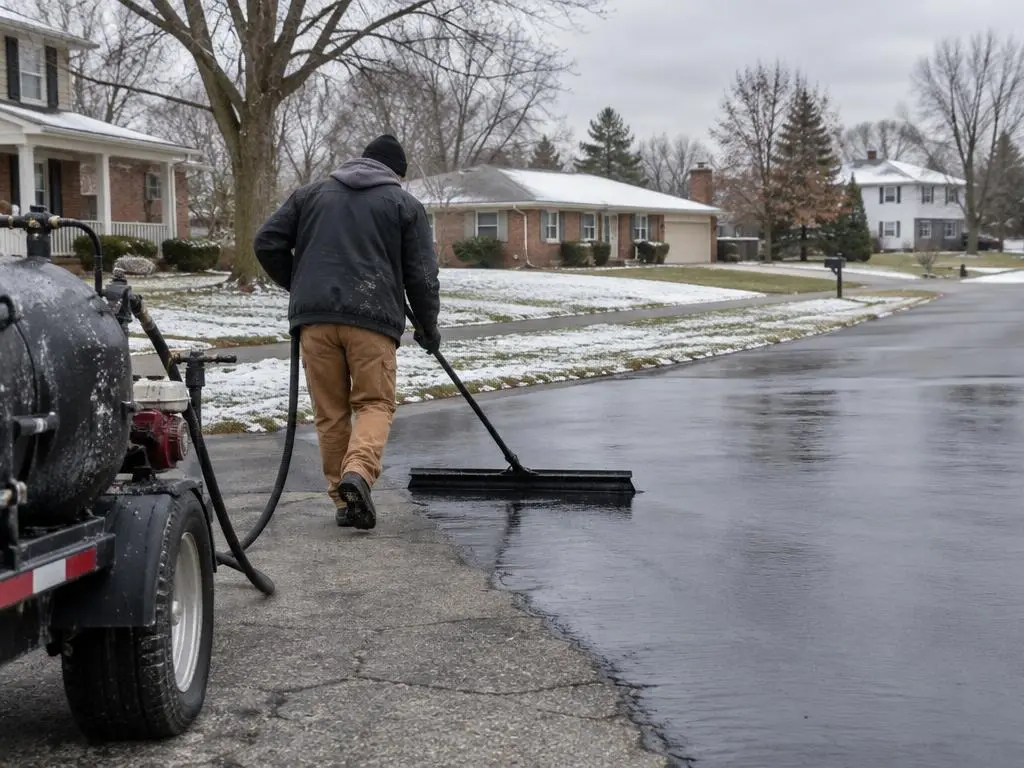
- Cut in and apply: edges are done by hand and the sealer goes down in even coats.
- Cure: the area is closed off. HomeGuide puts typical cure times at 12 to 72 hours before driving, and a few hours before walking.
Sealer types
Coal tar emulsion and asphalt emulsion are the two most common sealers. HomeGuide notes that many areas have banned coal tar emulsion over health and environmental concerns, and that asphalt polymer emulsion is considered the greener choice, though gas and oil stain it more easily. We name the product we plan to use before we start.
Salt and plows
Winter salt does not dissolve asphalt the way it can scale concrete, but brine keeps the surface wet through freeze-thaw cycles and works into open cracks. A sound sealcoat and sealed cracks limit how much water gets in. Plow blades scrape sealer off high spots, so heavily plowed lots may need resealing sooner.
Is it worth it?
For a driveway in decent shape, yes. HomeGuide lists driveway sealing at roughly $1 to $2 per square foot and $400 to $800 for a 400-square-foot two-car driveway, which is small next to the cost of resurfacing or replacement. For a driveway that is already failing structurally, sealcoat is mostly cosmetic, and we will say so.
What Sealcoating Includes
Most of the job is preparation.
Cleaning and oil-spot prep
Surface cleaned and stains treated so sealer bonds.
Hot crack sealing
Cracks filled before sealer goes down.
Sealer application
Even coats with hand-cut edges.
Restriping for lots
Lines repainted after the sealer cures.
Typical Sealcoating Costs
| Item | Published national range |
|---|---|
| Driveway sealing (HomeGuide) | $1 to $2 per sq ft |
| 12x24 driveway (HomeGuide) | $290 to $580 |
| 20x20 driveway (HomeGuide) | $400 to $800 |
| National average, driveway (HomeGuide) | About $600 |
| Parking lot sealcoating (HomeAdvisor) | $0.15 to $0.30 per sq ft |
National ranges from published cost guides, which each build their numbers differently. Central Ohio prices can run higher or lower, and removal, base repair, access and the size of the job change the total. Your written estimate is the price.
How It Works
1. Check condition
We note cracks and failed spots that need work first.
2. Quote
Square footage, crack sealing and repairs priced separately.
3. Prep
Clean, treat oil spots, seal cracks, patch.
4. Seal and cure
Sealer applied in dry weather; area closed until cured.
Sealcoating Questions
How often should a driveway be sealcoated in Ohio?
Every few years for most residential driveways, depending on sun, traffic and plowing. Lots that see heavy traffic and plowing may need it more often.
Can I seal a brand-new driveway?
Not right away. HomeGuide advises waiting three to six months so the asphalt can cure.
Will sealcoat hide cracks?
It darkens them but does not fill them. Cracks have to be sealed first or they keep letting water in.
How long until I can drive on it?
HomeGuide gives 12 to 72 hours, depending on temperature, humidity and the product. You can walk on it after a few hours.
Can you sealcoat in the fall?
Yes, as long as days stay dry and mild enough for the sealer to cure. Once nights turn cold, the season ends until late spring.
Sealcoating Service Areas
- Asphalt Paving in Columbus, OH
- Asphalt Paving in Dublin, OH
- Asphalt Paving in Westerville, OH
- Asphalt Paving in Hilliard, OH
- Asphalt Paving in Grove City, OH
- Asphalt Paving in Upper Arlington, OH
- Asphalt Paving in Gahanna, OH
- Asphalt Paving in New Albany, OH
- Asphalt Paving in Powell, OH
- Asphalt Paving in Worthington, OH
- Asphalt Paving in Delaware, OH
- Asphalt Paving in Pickerington, OH
- Asphalt Paving in Reynoldsburg, OH
- Asphalt Paving in Canal Winchester, OH
- Asphalt Paving in Groveport, OH
- Asphalt Paving in Marysville, OH
- Asphalt Paving in Pataskala, OH
- Asphalt Paving in Plain City, OH
- Asphalt Paving in Bexley, OH
- Asphalt Paving in Circleville, OH
- Asphalt Paving in Sunbury, OH
- Asphalt Paving in Grandview Heights, OH
- Asphalt Paving in Whitehall, OH
- Asphalt Paving in Lewis Center, OH
Get a Sealcoating Estimate
Free sealcoating estimates in Columbus and nearby towns.